The electrification of logistics transport will lead to a substantial increase in electricity demand in the coming decades, particularly in industrial estates and along logistics corridors. This transition cannot be viewed in isolation from the limitations of the electricity grid (grid congestion). ElaadNL investigated Charging Energy Hubs (CEHs) as a possible solution. A Charging Energy Hub is a charging location where high-power electric vehicles are charged and where charging demand is actively coordinated with local conditions, such as available grid capacity, renewable energy generation, and electricity prices. This coordination takes place via an Energy Management System (EMS), which automatically controls the charging process. This allows, in addition to limiting grid congestion, to maximize the use of local generation and to optimize periods with low electricity prices.
Lower grid load, higher utilization of local generation
Simulations show that Charging Energy Hubs have a clear impact on charging behavior. By combining charging with local generation (solar panels and wind turbines) and storage, power demand is better distributed over time, and part of the charging demand shifts to times with more sustainable energy and lower grid loads. Compared to uncontrolled charging, the coordination between charging demand and local generation can be significantly improved (55% better coordination), and peaks in the evening hours are substantially reduced (57% of demand shifts away from peak hours). This indicates that Charging Energy Hubs can contribute to a more net-neutral deployment of charging infrastructure.
ElaadNL Webtalk - What is the potential of Charging Energy Hubs?
The report will be explained in the ElaadNL Webtalk on 19 March 2026 at 12 noon.
Five hundred promising locations
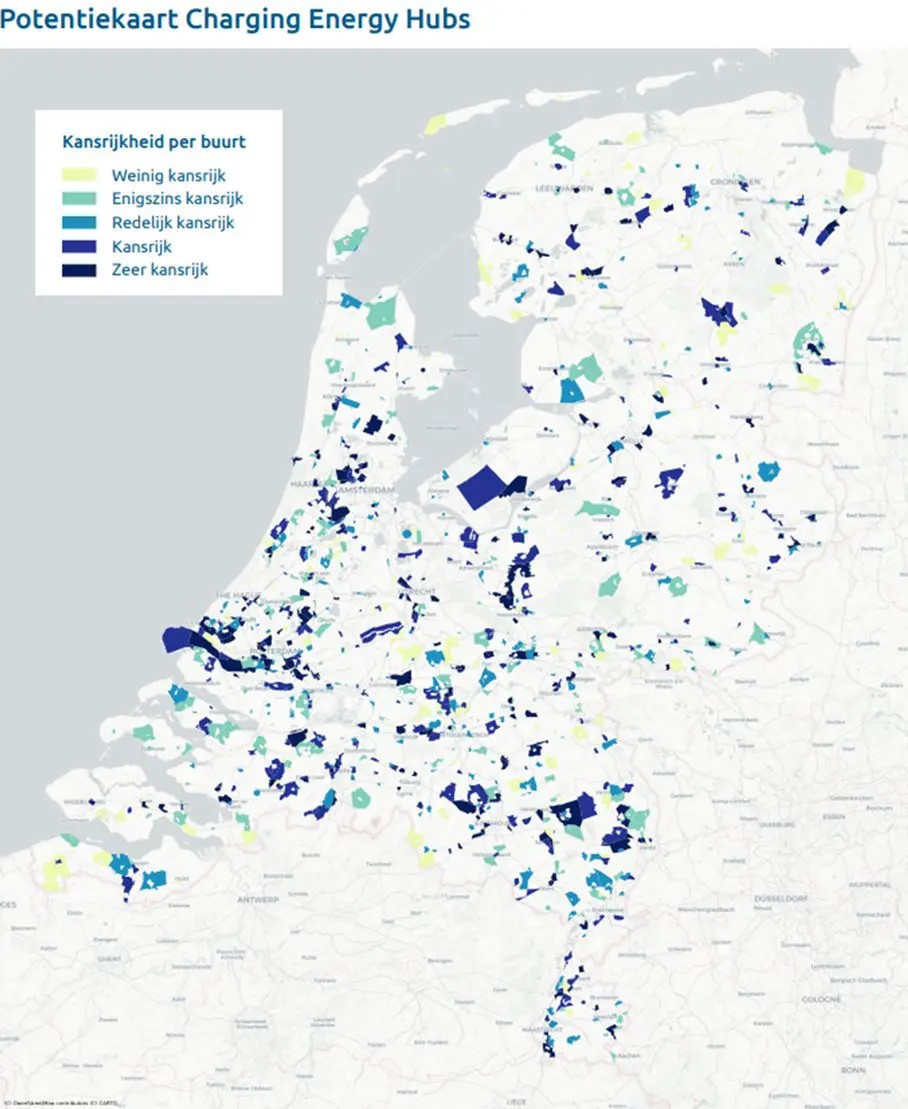
The spatial analysis in the report shows that there are around 500 promising locations for Charging Energy Hubs. These locations are primarily located on and around industrial estates on the outskirts of urban areas, near major transport corridors, and large-scale solar and wind generation facilities. These locations combine logistical scale, space, and energy potential, creating the conditions for smart charging solutions.
The study emphasizes that Charging Energy Hubs are not solely a technical solution. Their effectiveness depends heavily on collaboration between logistics users, the design of charging plazas, the chosen control strategy, and the local grid and energy situation. Furthermore, the researchers demonstrate that there are opportunities for Charging Energy Hubs with relatively little complexity.
Click here for an interactive display of potential Charging Energy Hub locations.
Combining construction and logistics
The extent to which these hubs contribute to cost control (lower electricity prices and cheaper connections), net neutrality, and congestion relief depends on the context. However, the study's analyses clearly demonstrate that collective, intelligently controlled charging concepts with local generation and storage offer clear added value compared to uncoordinated charging solutions.
Furthermore, the study shows that there are opportunities for bundling charging demand from the construction and logistics sectors. Combining charging demand from logistics and construction in Charging Energy Hubs creates new opportunities for the electrification of these sectors, better utilization of local generation, and reduced peak loads.
The insights from this research can be used to identify promising locations and to collaborate on collective charging solutions that fit within the limits of the electricity grid.
Download the full report
Download the full report here: ‘Charging Energy Hubs: Combining logistics, charging demand and local sustainable energy’ – January 2026