Autonomous driving: time for test routes on public roads
“Not everything can be developed on closed test tracks or in simulations,” says Grol. “It is time to create test routes for autonomous driving on public roads — under real-world conditions.” Countries such as Germany and France have already launched pilot projects. The Netherlands must follow suit. Industry associations are in close dialogue with the government on this matter.
At the same time, Grol makes it clear that the Dutch automotive industry has sharply defined its strengths: commercial vehicles, electrification and innovative materials. “One third of all heavy-duty trucks in Europe are produced in the Netherlands,” he emphasizes. Manufacturers such as DAF are also driving the electrification of heavy commercial vehicles — a segment that is of crucial importance to Germany’s logistics sector as well.
Sustainable mobility requires progress in materials and charging infrastructure
The Dutch automotive sector places strong emphasis on lightweight materials. Where steel sheet was once predominantly used, aluminium components were later introduced. Today, carbon fibre is playing an increasingly important role, as it is not only extremely strong but also significantly lighter and therefore more efficient than steel or aluminium.
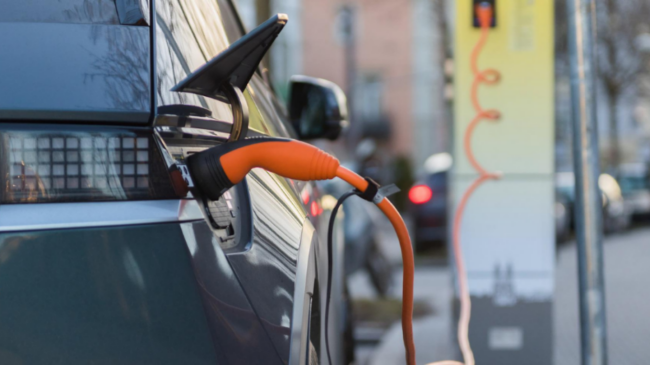
The Netherlands is also well ahead when it comes to charging infrastructure. With more than 200,000 public and semi-public charging points, the country has one of the densest charging networks in the world. Germany plans to install one million charging points by 2030, but is still struggling with grid congestion and unclear subsidy structures.
Challenges for electric trucks
Despite the progress made, much work remains to be done. Grol cites concrete figures: “Of the tens of thousands of electric trucks we will need in Europe by 2035, fewer than 1,500 are currently on the road.” Manufacturers such as DAF are able to build attractive electric trucks, but logistics companies face infrastructure challenges: overloaded power grids and too few fast-charging stations along key transport corridors such as the A2. “It is crucial that governments take action in these areas,” Grol stresses.
Sustainable mobility: a European challenge
The electrification and decarbonisation of road transport is a key issue across Europe. No country can achieve this on its own. Looking beyond national borders is essential in order to combine the strengths of neighbouring countries — including Germany. The two countries complement each other well: Germany contributes production capacity, a dense supplier network and strong research institutes in the automotive sector, while the Netherlands serves as a test market for innovations with expertise in smart mobility and logistics. Concrete collaborations already exist. Dutch manufacturers such as DAF, for example, work closely with German logistics companies, including on the electrification of transport fleets.
In 2025, the EU presented an action plan to restore the international competitiveness of the European automotive industry through investments in e-mobility, batteries, software, AI and autonomous driving. A key focus of this plan is, among other things, support for battery and charging infrastructure.
As part of numerous cross-border trade missions, the Dutch sector presents itself to potential German partners.
Click here for the original article.