
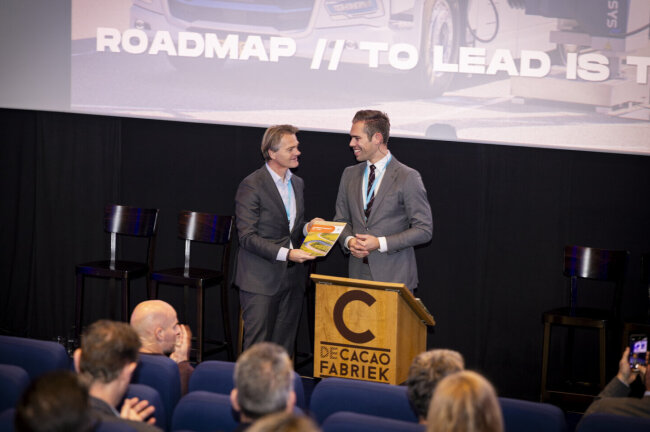
The Dutch automotive industry stands at a crossroads. Companies are facing raw material shortages, increasing international competition, supply chain uncertainties, and a European market that is changing faster than ever. During the industry summit autoMEETive 2025 in the Cacaofabriek in Helmond, RAI Automotive Industry NL issued a clear warning: without acceleration, collaboration, and strategic decision-making, the Netherlands risks losing its leading position in innovative mobility.
The Automotive Roadmap 2025–2035 outlines a shared vision for how the sector can reinvent itself in the coming decade, remaining both economically relevant and technologically advanced.
“We all feel it: the pressure is rising.”
Pim Grol, Managing Director of RAI Automotive Industry NL:
“The pressure in our sector is tangible. Raw materials are becoming scarce, digitalisation is accelerating, geopolitical tensions are increasing, and companies must invest in sustainability while margins are under pressure. This creates opportunities for our industry, but it also means there is no time for small steps. We must dare to make choices and look ahead.”
Grol emphasises that the Automotive Roadmap 2025–2035 is not a final product, but a call to action, a compass enabling companies, governments, and knowledge partners to align their efforts toward a strong Dutch mobility ecosystem.
“It’s about resilience, not prediction.”
Jean Pierre Heijster, Program Manager at RAI Automotive Industry NL:
“No one can predict exactly what mobility will look like in 2035. But we do know the direction we need to take: smarter manufacturing, lower emissions, and deeper cross-sector collaboration. The roadmap doesn’t help us predict the future; it helps us become resilient enough when that future arrives.”
Shared challenges require a united course
Throughout the event, it became clear that many companies face the same concerns:
- Rapidly innovating international competitors offering lower costs
- A shortage of technical talent
- The necessity of digitalisation and automation
- Uncertainty about regulations, infrastructure, and energy availability
The Automotive Roadmap 2025–2035 provides a common foundation to address these challenges systematically, while emphasising that real change stems from collaboration and courage.
Where the major opportunities lie for the Dutch automotive sector (2025–2035)
Despite the mounting pressure on the sector, the new roadmap shows that the Netherlands is well-positioned to accelerate.
With its strong high-tech manufacturing base, the country has everything needed to become a European frontrunner in smart, predictable, and low-carbon production. In addition, the Netherlands’ exceptionally advanced digital infrastructure creates major opportunities to enhance road safety through ADAS integration, intelligent traffic systems, and safe automation.
New opportunities are also emerging throughout the supply chain: from circular materials and battery recycling to tighter collaboration between OEMs and suppliers, making value chains more resilient to geopolitical shocks.
At the same time, the Netherlands can safeguard reliable mobility for citizens and businesses by developing energy hubs, smart charging infrastructure, and innovative logistics concepts within a changing energy system.
A final, but crucial, opportunity lies in talent development. With strong technical education and innovation-driven universities, the Netherlands can train a new generation of high-tech automotive professionals—an essential condition for maintaining competitiveness.
The challenges are significant, but the opportunities are equally compelling, provided the Netherlands is willing to set a clear course now.
Sector unites
The presentation concluded with a clear call to industry, government, education, and research institutions: the roadmap is the starting point for a unified movement.
Not waiting, but choosing.
Not fragmenting, but collaborating.